Sunday, April 23, 2017

The Blessing of Living without Fear

Lately, and once again, even after four and a half years in Honduras I am overwhelmed with God's goodness and faithfulness to us and to the keeping of His word and His promises. What overwhelms me is how blessed we are to be here. What amazes me is that we thought we were giving up our lives, our income, everything we had worked so hard for, by moving and following God and our hearts to a foreign country. How wrong we were!

When I look at all we have gained, how much richer and fuller our lives are here, I don't know why it took us so long to get here.

This is NOT a post bragging about what we have done or obtained, but testimony to what God can do if we allow him to. I am not so naive as to believe that bad things can't, won't and haven't happened to us here. Nor that somehow we are exempt from stress, problems, challenges, sadness or even death nor so blind as to think that life in a third world country is paradise here on earth and without it's own unique issues. Life goes on all around us, enveloping us in it's chaos, turmoil, blessings and rewards. What I am saying is that obedience to God, faith in His eternal Goodness and living life without Fear produces a type of blessing unique unto itself. 

I have learned, and continue daily to learn, that Fear is one of the greatest inhibitors to enjoying the abundant life God promises. Over the past several months this has been reinforced over and over again through the Bible studies we have done in our Tuesday night home fellowship group and with it a new understanding of God's amazing plan for Reconciliation, for Provision and for Rest. It is Fear and Unbelief that most often keeps us from benefiting and enjoying what God has promised His children.

I won't lie to you. We have faced severe challenges since we moved here, but through it all the blessings we have received far outweigh the problems we have experienced. 

Some of the blessings we experience here, and only because we are here are:
  • A fourth son, Carlitos. If we had not been obedient to God's command to care for orphans in their time of distress we would have missed out on the incredible blessing (and challenge) it has been to have another child. I can't even imagine what our life would be like without him. Much quieter I suppose, for one.  I'll be honest, my single, greatest fear right now is that, even though our file has been accepted, the adoption won't go through. Recently, I have been challenged to release that fear and to rest in God.
  • I closed a prosperous and established business to move here. But, God has blessed us now with 6 growing businesses and two more in the works. After going without a paycheck for the first two years we were here and living mostly on savings, we are better off now than when we arrived. I can't explain it other than to say God is faithful.
  • Our three sons work with us, enjoying part ownership of all we do. This is one of the greatest blessings I have ever experienced, and I doubt that if we had stayed in Maine this would have been possible. The endless opportunities that exist here has made it possible to enlarge our parent company, Inversiones Wolfe Honduras, to include a variety of businesses, thus providing work for the entire family that matches our interest and job skills. Being a key part of watching my sons grow and develop as businessmen, shouldering responsibility.....well, words cannot describe what I feel.
  • We have a ministry and a purpose here which we never experienced in Maine. What we do through the Spanish Institute of Honduras, through our Bible study in Cerro Azul and our home fellowship group is deeply, deeply rewarding. Helping new missionaries through their first months in a new country to learn the language and navigate culture shock is Kingdom work with a capital K. Watching the spiritual growth in those who attend our Bible study in Cerro Azul is nothing short of amazing and a true testimony to the enabling power of the Holy Spirit in a believer's life. Our home fellowship group; mmmmm, nothing I can say will express the gratitude I have for the many, many wonderful people who have blessed and encouraged Barbe and me these past four years. In 25 years of serving God I have never, ever experienced anything that compares to the depth of relationship and fellowship, the shared joys and tears, the actual Christian community that we experience on Tuesday nights and throughout the rest of the week with those who are willing to open their own hearts and to share life with us.
  • Opening our house to host the Institute and any traveler who happens to come our way has been a blessing and, yes, at times a challenge. When we first decided God wanted us to move the Institute here and to live in the same building, we had many people tell us it was a mistake and we couldn't or shouldn't do it. Once again, I won't lie; it has had it's challenges, but those have been far offset by the blessings we have received in return, by the people we have met, and the relationships we have made; all of this has only been possible because we chose to follow God's lead and give up what we thought was our right to privacy. I have learned that as a family we do need that quiet spot away from the business and busyness of having 60+ people in our house five days a week, and I believe that God is at work preparing just such a place for us.  
  • It's a fact that we left friends and family, and while these cannot be replaced, I will say this: God has expanded our family here in Honduras 100 times beyond that which we had in United States... just as he promises to do if we allow Him too...and really, we didn't actually leave those in the US behind thanks to the modern technologies of the Internet and air travel. 
  • The incredible opportunity to learn a new language and to live in and enjoy another culture...priceless.

I'm going to write honestly here and hope it does not offend. When I hear missionaries complaining about life in Honduras I'm not sure what to think. I seem to sense that many feel that somehow or another they have made some great sacrifice for God by moving here. Maybe what we are experiencing here is not the norm. Maybe we haven't sacrificed enough for it to hurt as others seem to have (I'm speaking tongue in cheek). I don't know, because I just don't see it that way. As my friend Tim says, also tongue in cheek, "Just suffering for Jesus". 

To me, this whole missionary thing is the best kept secret in the world. Shhhhhhh, don't tell anyone.

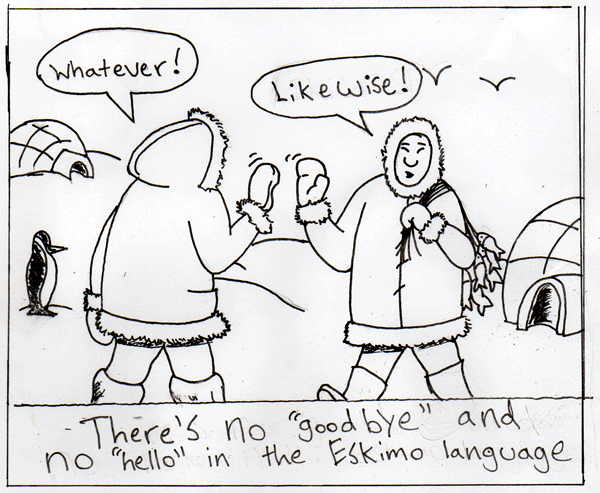
Sunday, December 11, 2016

Fluency, the Use of the Conditional Tense, Diplomacy and the Latin Culture

As the owner of the Spanish Institute of Honduras for the past four years I have learned so much about languages and how we learn.  Not necessarily the art of teaching Spanish as a second language, I leave that to our abundantly qualified staff, but rather the challenges we English speakers encounter in learning Spanish as a second language. One of the seldom-mentioned challenges we face is understanding the differences between the Latin American and North American cultures as it pertains to the actual use of the language. Tied into and intricately connected with this issue is obviously the speaker's level of fluency.  Even as I continue to study and practice, I am aware of how much I still lack in my own understanding of this subject, which only amplifies my own desire to continue improving.

Several months ago a friend asked me to blog on the "conditional verb tense and its use in diplomacy and its cultural implications."  I have procrastinated in doing so, mainly because it is actually rather complicated...and delicate...and sensitive…, but most of all because I know I will never be able to do the subject justice.  All I can hope for is to sufficiently pique your interest so that you begin your own pursuit of the topic, especially if you are a missionary or working for an NGO in Latin America.  If you learn this tense, when and how to use it in its culturally appropriate context, you will be doing yourself and those you wish to serve a great service.

Unfortunately, in my experience, many missionaries and foreign aid workers stop far short of this level of fluency. Some because their sending agencies themselves do not recognize the long-term value in reaching fluency, some because they are unwilling to invest the nine months to one year that is needed to achieve it, some because of innocent or willful ignorance of the importance of being fluent and understanding the culture, and some because of pride, but all to the detriment of the mission. I have witnessed time and again the negative results of going only part of the way towards learning the host culture's language. The results I routinely observe in these missionaries are: a life frustrated by a lack of fluency that makes even normal daily life difficult (most often ending in a premature return to their home country), the inability to fulfill their calling or to build deep, meaningful relationships and in some cases a complete dependence on translators. In several unfortunate scenarios I have witnessed relationships destroyed because of their inability to fully and appropriately express themselves, especially in this area of understanding the cultural use of the language and its tenses.


In my opinion, ignorance of the cultural issues associated with the language is a direct result of the teaching method used in high schools, universities, and most language schools. In these contexts, the emphasis is typically on how to conjugate the verb in the conditional tense and where to use it in a sentence, never on its cultural use.  As an example of this problematic method, I have included the following explanation of the Conditional tense from StudySpanish.com (which is otherwise a very good resource and one we recommend to our students)

“Frequently, the conditional is used to express probability, possibility, wonder or conjecture and is usually translated as would, could, must have or probably."
Note: Some people confuse this tense with the subjunctive because of some similarities.

Notice there is nothing said about the use of the conditional as an expression of courtesy or as a way to mitigate a strong statement or to make a request sound more like a request and less of a demand. It says nothing of how to use it in order to be diplomatic in a disagreement or to present a differing opinion in an inoffensive way. Here is where the cultural value of the conditional should be understood and, hopefully, wielded with at least some level of skill.

In simple terms,
using the conditional tense versus the present tense is the difference between;
can I and could I, will you and would you or we want and we would like.
__________________________________________________________

I first became aware of the importance of this verb tense during a refresher course I took several years ago with one of our senior teachers. During the lesson I asked her to describe how most North Americans sound culturally to Hondurans. She blushed and at first did not want to answer. When I finally coerced her into telling me, she said "After years of working with Americans I am still shocked at how direct you all are." As she gave me real-life examples I sensed that this topic truly deserved my attention if I was serious about living, working, and ministering effectively in Honduras. Now I find myself constantly listening to Hondurans and how they phrase certain things.  I listen to Gringos and try to hear them as a Latino hears them, especially while expressing opinions or asking for something.  I listen to the tone of voice, the grammar, and the phrasing.  What I hear from Americans is most often direct, abrupt, bordering on rude, and usually totally acceptable in our own culture. Except we aren't in our own culture. We are uninvited guests in someone else's country, in someone else's culture.

By nature I am not a particularly diplomatic person.  I prefer direct, open discussion rather than polite statements - strong and earnest debate over beating around the bush.  I often become passionate about a subject. My blood boils easily. In fact, I am a typical North American. Because of this, I recently felt the need to apologize to a friend of mine, a former congressman, after a phone conversation during which I became a little too "energized."  As I hung up, I found myself involuntarily cringing as I replayed our conversation as he must have heard it. I saw him in the store a few days later and I told him I needed to ask his pardon. He laughed and asked what for, to which I replied, "During our conversation the other day I spoke to you like a Gringo. I'm sorry." He, with true Honduran politeness, kindly denied it, but I knew it was true...and I know he did too.

However, I'm learning.

A couple of years ago I was honored to participate in a community water project meeting sponsored by FAO and my friend Marlen. I learned by listening to her how to present an opposing idea in a courteous manner. A long, thoughtful pause followed by "o...podria ser..." (very long rolling of the R in ser ). How simple and polite to say, " or...it could be..." And how different from, "No, that won't work, we should do it this way" as we Americans would say. Almost weekly I sit through community meetings, water project meetings, business meetings, staff meetings, contract negotiations, and more. With each experience I gain a little more insight into the Latin Culture. Little by little I am learning, but I'm only learning because it's important to me to represent myself, my business, my mission, and most importantly the One I serve to the best of my ability.

I admire my friend Tim Nelson in many ways. He and I are the same age and I admire the fact that he still has a full head of hair (well, that feeling may be closer to envy than admiration, but there's a fine line between those two emotions anyway).  Tim grew up in Latin America and has lived there most of his life. He uses the conditional tense without even knowing he does. More importantly, Tim understands the culture. He understands that in Latin America how we express our doubts, opinions, and differences is very important. I have never seen Tim offend anyone by the way he says something. That Latino sensitivity to speech is exhibited in the way Tim speaks to Americans as well. It makes me think that maybe the way we Americans do things isn't always right after all. Podria ser?

As I read this before posting I realize there is so much more that could be said or should be said. I realize that, just as I feared, I did not do the subject justice. However, as someone who does have a fair amount of experience in this area, let me end by saying this. If you are studying Spanish, by all means learn all the "hondureñismos" and all the slang you can. They're cute and they too have their place in the culture. But if you want to be respected, if you want your opinions to be valued, your input appreciated, and if you want to be inoffensive in your speech — learn the conditional tense and how to use it properly.


Note: Should you be interested in taking a class that is specific to a grammatical/cultural topic such as the conditional tense (or any other tense), we offer one-on-one lessons geared specifically to your needs and your level of fluency here at the Spanish Institute of Honduras. Visit us at www.ispeakspanish.org or on Facebook for more information. We now have online classes available at spanishinstituteofhonduras.com or contact us by email at mark@spanishinstituteofhonduras.com for more information.


"Come as friends, leave as family" - The Spanish Institute of Honduras, Thanksgiving Day, 2016

Saturday, November 26, 2016

To my Father

My father was born on the 31st of January, 1931. Only days ago, in the early morning hours of October the 12th, 2016, I was with him as he drew his final breath. The reality of his passing has still not fully woven itself into my consciousness. Even now, as I sit in the kitchen of my parent's home of 45 years, the place that for me will always remain my own heart's home and the wellspring of most of my childhood memories, I wait for him to come and sit at the table with me. And I remind myself, again, that he is not coming. For those of us who loved him, an era has come to an end.

One of my favorite photos of Mom and Dad, Aug 1952

My father was an unusual man in so many different ways. I have never met anyone less attached to, or driven by the need to accumulate material possessions. As one of my siblings pointed out; he never coveted a new or even a better car, never had a hobby, never worried about the loss of what he did have, nor did he leave behind one significant item, not one, that we could say, "Let's keep this because it reminds us of Dad." The one thing he cherished was his home. It wasn't the sticks and shingles or the fixtures and furniture that he was enamoured with - the good Lord knows all that would have collapsed around his head years ago if Mom hadn't kept up on it - but what he loved was the essence of "home". His desire was to stay there until he died, and he did just that.

It wasn't as though Dad had no affections for this world or that he left nothing to us. He loved the beauty of creation and he imparted to me this same love and appreciation long before his passing. Each time I find myself marveling at the sheer beauty of a fire-wrought sunset, the vast sweep of valley merging into spired mountains or breathe in the summer-scented air of that golden hour of each day we call evening, I sense him revelling in it with me and through me. Dad loved adventure and travel and I too share with him the same wanderlust, the same restless spirit, the same desire to see what's around the next bend in the road and the willingness to go find out. These then are a part of my inheritance, and when I consider them I find them to be of far greater worth than a pocket watch, a table saw or a collection of CDs.

The greatest pursuit of my father's life was God. I wish that I could write that because of this he - and by extension, we, his family - had an idyllic life. Sadly, this was not the case. His quest for personal holiness not only lead us down some very difficult and heart wrenching paths, but actually caused nearly irreparable spiritual damage to my family that is only now beginning to heal itself. My father's minimalistic personality combined with his austere perspective of faith, eventually lead him to build a church and a life based on the doctrines and examples of the early Quakers, who he revered. Despite the fact that my father adhered to some very odd and somewhat works based beliefs, I know that for the past 55 years he loved the Lord and lived his life according to the light given him - as the Quakers would have said. Because of this, I respect my father and have assurance that he is in Heaven, and I want share the events that took place in the final week of my father's life. It is my own faith bearing testimony to the power of God at work.

Dad and Mom (center) cerca 1977


Dad, my grandmother and Mom during the 11 years away from his church


Those of you who follow my blog are aware that we moved to Honduras four years ago. Having lived just down the road from my parents for years, not being able to drop by whenever we wanted to has been difficult. This past summer, I begin to feel an increased urgency in my spirit that I needed to visit them - soon. Because of this, I booked tickets for myself and Thomas several months ago, clearing our ever busy schedule for a two week visit. Four days before we were to leave for Maine, we received the shocking news that my father had only weeks to live.

The pillars of my life were shaken. I knew this day was inevitable, but this was so unexpected. My parents had been the one constant in my life for 53 years and now I was being asked to envision my world with a father shaped hole in it. On the flight from San Pedro Sula to Boston I selfishly worried about what I would say to him when I arrived. What does one say to someone, especially someone you love deeply, when they have just found out that their time on this earth is short? I'm sorry? I will miss you? This isn't fair? Every thing I thought of seemed shallow and puerile. I called several friends who I knew had themselves confronted this day, seeking advice. Each one said the same thing in different ways. "Mike, you are being given a gift that not everyone is given. You have the chance to say good bye, to remember the good times together and to be there for him. Just say I love you."

And that is what I did. I spent ten quality days with my dad. We spent time together. We reminisced. We visited the cemetery where he would be buried. We laughed together even as I tried hard not to cry. And I told him I loved him. On Saturday, just a few days before he passed, we had a family get-together filled with food and laughter and love. It was a beautiful New England fall day, crisp and cool, the trees a flaming barrage of color. My dad was feeling good and he sat on the porch railing and once again told us the stories of his life, of his and my mother's courtship, of his time in Korea and the early days of his childhood. It was a good day, a blessed day.

Thomas and I were scheduled to leave for Honduras on Wednesday. Dad was looking good and doing well, and I was fully prepared to fly back to Maine as soon as needed. On Tuesday, the day before we were to leave, Dad woke up feeling weak. Up until that day he had experienced very little pain, had been walking on his own, and was completely cognizant. At noon I helped him to the restroom, carried on a conversation with him and then helped him sit at the kitchen table. Shortly afterward, his conversation became jumbled and confused and within an hour he had drifted into a nearly comatose sleep. I called the airline and cancelled our flights.

Hospice delivered a hospital bed that evening and we made room for it in the kitchen, his favorite room in the house and the place that for years most of our family's indoor life had taken place. My sister, who has been a nurse for many years, warned us that Dad had entered that transition from life to death and that it could be several several days before he passed on.

At different times throughout the evening, we gathered around his bedside and sang his favorite hymns. Even from the depths of his sleep he tried to sing with us. We prayed together as a family. We took turns in private saying goodbye. We told him we loved him and that it was okay to leave us whenever he was ready.

As evening turned to night, several of us sat near his bed in the dimly lit kitchen, the house quiet except for the ragged breathing of my father. I picked up my Bible and began to read aloud some of the great passages of Scripture, those with a promise for all who believe in the Great King and in His promise of Life Eternal. I read, my voice breaking often as I tried to stem the tears, and as I read his breathing softened and lost it's harsh rasping. A peacefulness came over the room. Eventually, I turned to Isaiah the prophet and read that wonderful invitation given to each of us, we who have nothing to offer in exchange for God's grace and salvation.

"Come, all you who are thirsty, come to the waters; 
and you who have no money, come buy and eat!
Come, buy wine and milk without money and without cost.
Why spend money on what is not bread, and your labor on what does not satisfy?
Listen, listen to me, and eat what is good and delight in the richest of fare.
Give ear and come to me; that your soul may live."

I continued reading into chapter 56, my ear tuned to his now peaceful breathing. I read these verses:

"And foreigners who bind themselves to the Lord to serve him,
to love the name of the Lord, and to worship him, 
all who keep the Sabbath without desecrating it and hold fast to my covenant" -

And as I read the following verse, I heard him breathe his last, a breath and a half, and his spirit left his body and winged it's way towards heaven, lifted and carried higher and higher by these words.

"These I will bring to my holy mountain
and give them joy in my house of prayer." (Isa. 56:7)   

I knew he was gone, but I continued reading not wanting that moment to end. All that week the tears and the sadness had lingered just below the surface of every conversation, of every thought, but the moment that my father's spirit left his body I was filled with an inexpressible joy that filled my being. It was heaven's own joy and it was for my father, because I knew that for perhaps the first time in his life he was happy and at peace. The gloriousness of what he was experiencing was made real to me in that moment and it was as though I could see my father leaping and bounding towards the One whom he had sought for so long. All of his questions and the imperfections that had plagued and driven him for most of his life were being answered and washed away. The verse in 1 Corinthians 13 resounded in my head, "For now we see as through a glass, darkly; but then face to face: now I know in part; but then I shall know even as also I am known." (vs 12)  My father was seeing face to face the great Creator!

____________________________________________________________

Note:    I wrote much of this post shortly after Dad's passing. I have waited to publish it because I wanted to hold my memories to myself for a time, to cherish them. I wanted to return to my wife and two sons who could not be there with us and share with them the intimate details of those final days. On our return, we set apart an evening to spend together sharing "Papa" memories. I told them this and other stories of his last days and moments on earth, as we laughed and mourned together. Today I share this with you. If even one reader finds peace, or wisdom, or comfort, or hope, or solace, or joy, or salvation through this account, then I gladly open my heart to you.

My father was far from perfect, but I learned to love him through and in spite of his faults; and that is perhaps the greatest love of all. Even as I put the finishing touches on this post, I do it through a blur of tears. As I write, I have stopped often to weep and to mourn again my father's passing. I mourn for what could have been and I mourn for what was and what is lost and what will never be. But, I rejoice in knowing that he and I will meet again, and that all my own imperfections and the things that at times make me unlovable will also be washed away, even as his has been. I rejoice in knowing that his death has brought me and my family closer together than we have been in years. And I rejoice that God's Word is proved true and trustworthy.