Sunday, March 31, 2013

Las Alfombras de Comayagua


One of many "alfombras" and  still in the process of being completed.

Semana Santa, or Holy Week, is very much celebrated here in Latin America. Many people take vacation during this time. Most banks, businesses and even the buses shut down, at least for Good Friday, sometimes for the entire week. Good Friday, the day Christ was crucified, is, as one person put it, the day most respected in Honduras.

Comayagua is about 30 minutes from where we live. The road winds up over a mountain, as most roads here do, and drops down into a much drier valley than that which Siguatepeque lies in. Comayagua is one of the oldest cities in Honduras, founded in 1537.  It was the first capital of Honduras and it's Spanish heritage is still visible in much of the architecture. It is home to two of Honduras' oldest cathedrals, one of which has in it's tower one of the oldest, if not the oldest working clock in the Americas, made sometime in the 13th or 14th century, or as some claim, the 11th century.

Comayagua has also, for the past 50 years, been famous for it's "alfombras" or "carpets" that people make in the streets each year during Semana Santa. These carpets are made, for the most part, from pine sawdust which has been dyed different colors. They are elaborate, intricate, colorful and very Catholic in the way that they portray the Crucifixion of Christ. I am well aware that there exist many differences between Catholics and Protestants, but I must say, the Catholic Church seems to be to able to express, in both art and tradition, the solemnity and momentousness of Christ's death in a way that we Protestants seem not to

Mark, Charley, Luis, me, Thomas, Barbe, Corey, Gavin, Garret and Kirsten. Standing by the fountain in the Central park, the Cathedral built in 1650 with the oldest working clock in the Americas stands behind us. Both clock and cathedral have been renovated.


Because of this solemnity, as we walk along the streets admiring the artistry with which each carpet is created, there really is a sense of worship and remembrance in the attitudes of the people around us. A nun, eyes closed, lips moving in silent prayer stands alone, surrounded by people. Families move together, slowly, through the calles, taking time to admire each carpet. The usual throbbing, pulsating, hard driving beat of music emanating from loud speakers, so prevalent in most of the cities here is absent, prohibited by law for this one Day. For this I am very thankful.
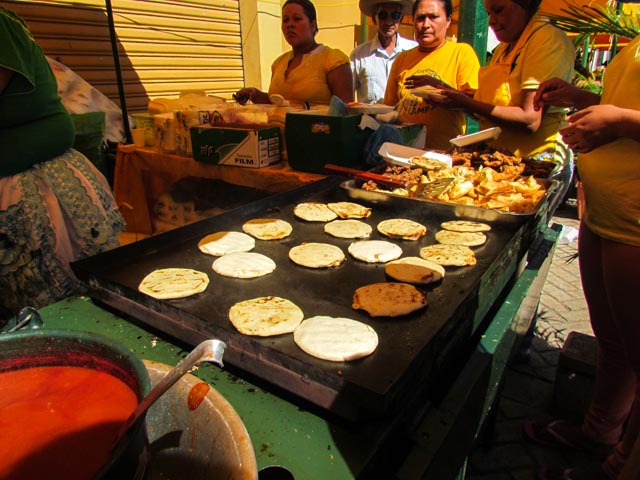
We eat pupusas purchased from street vendors, washing them down with Pepsi. We're in the minority here, Coca Cola being the drink of choice for most Hondurans. We have invited some of our friends from Siguat to ride with us. Reyna, Gaby and some of their family have come. Trey, the Wells and Luis are here too, and a new friend we have met only recently while at the retreat in Valle several weeks ago, Charley Jackson, has driven all the way from Tegucigalpa to spend the day with us. Charley lives on one of the mountains surrounding Teguc, in a very dangerous part of town. He loves the Honduran people in his neighborhood and helps them as much as he can, when he can. We love Charley and it is an honor to have him as a guest in our house.


Luis and me enjoying a lunch of papusas.


Las Familias Mendosa y Garcia (I hope I got that right)


Thomas and Luis filling bottles with sawdust.

After the procession has passed, children rush into the streets to fill bags and bottles with the sawdust from the carpets.

It is a beautiful day. The weather, which had been cold and rainy only the day before, is perfect. The ride from Siguatepeque in our van filled with friends has been an incredible blessing to us. I want to say thank you to my brother Jon, for suggesting we buy a van for our trip down here. It has become, as our friend Kirsten calls it...the Party Bus. Aren't road trips with friends the best! We're already planning several more.

I want to take just a moment, this Resurrection Day, to acknowledge the One who gave His life for me and for whom I live. We are here in Honduras because of Him. I know that there are many of you who are following my blog and our life here in Honduras who do not profess faith in Christ, and out of respect for you I do not express, overtly, in this blog my religious sentiments. (I write another blog for that). But, I would be remiss if today, as Believers around the world celebrate Easter, I did not give thanks for what Jesus has done for me. Without His death and resurrection, my life, both now and for eternity, would not be the same.


Monday, March 25, 2013

La Ducha

First I want to say thank you to all of you who are lending to help Allan and Nicole start the chicken farm. Since Saturday morning when I first posted this project, almost 30% of the funds needed have been pledged. I want to apologize for the extremely poor grammar and spelling in Saturday's email. I was in a hurry and forgot to proof it and do spell check. Totally embarrassing! I did want to clarify two things. 1. Any amount you wish to loan is gratefully accepted, but because this is a pilot program smaller loan amounts are recommended. 2. Your loans are not tax deductible nor do we guarantee repayment.

La Ducha
This is what most people in Central America use to heat the shower water, if they use warm water at all. Most of these "hot water heaters" are 240 volts. Because of this, some people call them "widow makers". I cringe every time I reach up and turn the switch on or off, wet and standing in a pool of water. Water temperature is regulated by the water flow. You want cooler, turn up the water volume. For those worried about the dangers of this system, a cold shower would be the obvious solution. Of course, a Gringo taking a cold shower runs the risk of having a heart attack.

La Ducha
Another thing that seems to happen often is what one man I know refers to as "stray voltage". Sometimes when you turn on a faucet you get a little tingle, especially if your hands are wet. I think it's because most houses here are not properly grounded.

Some of the other things I miss in the bathroom are; a really long, hot, strong shower, shaving with hot water, (most tap water is only cold water) being able to brush my teeth and rinse with tap water and, last but not least, being able to flush used toilet paper down the toilet. All these things just take some getting used to.

A few other updates.
Friday I went to Comayagua to get my RTN number. Having this makes me an official taxpayer here in Honduras. As best I can tell this is equivalent to our Social Security number, but with out the benefits. I needed to get this in order to import and register our van, but it is used for almost all other business transactions as well.

After a few colder days, the weather has now turned hotter and a bit more humid, but not unbearably so. I think it was about 90 F yesterday. We are headed into the hottest, driest month of the year, April. The air is hazy, partially from the humidity, but also because many farmers are burning their fields in preparation for planting as soon as the rainy season begins.

Water rationing has begun in earnest. Many people are only receiving water every 3 days and some as little as every 8 days. I know one lady who hasn't had water for 2 months in her "barrio", this perhaps for reasons beyond rationing.

I am closing in on a location to drill our first well in June. Getting the well drilling up and going has been a little difficult because of a lack of funding for the project, but thanks to New Generation Fellowship in Jacksonville, FL we will have opportunity to do this soon. They will also be our first team. We lovingly refer to them as "our guinea pigs".

Last Saturday, we went on a hike with the Wells and the Foster boys. Hiking down a trail through a pine wood, we eventually got to a small waterfall with a swimming hole. There were quite a few young people already there. This is Semana Santa and traditionally it is week when many people head for the beach or the rivers to swim. Afterwards we stopped at the Mennonite farm for home made ice cream. I also made the mistake of asking for manteca instead of mantequilla, the difference being lard and sour cream. Take it from Christina, lard does not go well on frijoles. Oops!


The swimming hole


The advantage to living in a free country. We can still do this here.

Saturday, March 23, 2013

Our First BAM Project; starting a chicken farm with a micro loan

This post is dedicated to our first Bam project. I'm so excited about this. I have been planning, researching, working and praying for this for many months. There is another, smaller project in the works as well. If this is your first visit to this blog...bienvenidos!

Allan and Nicole

Below is a brief synopsis of our first BAM project and the couple asking for a micro loan. Before I introduce you to them I want to explain something. This small business venture was not my idea. It was theirs. Why is this important? Because it means that it is far more likely to succeed. To work to make your own ideas and dreams come true is always better than trying to make someone else's ideas come true. All I did was bring some wisdom and experience gained from my many years of self employment to the venture and help bring you and them together. So, I want to make sure that the credit goes to these folks, for their intuitiveness in searching for a business that suits them and for being willing to accept my small role in this and agreeing to the requirements we ask of them wholeheartedly. Allan and Nicole, may God richly bless you and those who lend to you in this new venture.

I first met Allan and Nicole a little over a year ago. Oddly enough, if my memory serves me correctly, it was over a carton of eggs. But let's start at the beginning.

Allan
Allan is Honduran, born in a small village somewhere in the mountains on the North Coast. One of nine children abandoned by their parents, he was raised by his older siblings. Allan graduated from the 3rd grade and never returned to school. Instead, he and a friend decided several years later to head for the US. They were fourteen years old. They walked and hitchhiked their way north, working when they could, begging for food when they couldn't. Several months later they crossed the Rio Grande and were picked up by INS. Kept in a detention center for six months, Allan was eventually united with family members who lived in Dallas and was able to remain in the US legally because of them. He taught himself English and improved his reading all the while working as a house painter.

At some point he began attending church, eventually ending up in the church Tony Evans pastors in Dallas. Under Evans' teaching and God's leadership, Allan developed a real heart for missions and evangelism. In 2010, Allan failed to renew his paperwork with INS and was told he had to return to Honduras. He returned with enough money to buy a small, adobe house on a large lot in one of the small aldeas outside of Siguatepeque. He has done a wonderful job remodeling the house. It is cozy, quaint and very comfortable. Allan is a pastor and an evangelist at heart. He's not sure that he will ever see himself as the pastor of a church with a buildings and all, but he has several families in the aldea that he cares for and who faithfully meet in his house every Sunday.

Allan is one of the friendliest guys you'll ever meet. He is also one of the most talented too. There is no doubt in my mind that he is made for self employment. As we have talked about BAM philosophy...he gets it. Already he is thinking of ways that he can help the people in his home church through this business. He's inventive, intelligent and has previous experience raising chickens.

Nicole
Nicole is from Texas. She loves children and has worked in camps and an orphanage often over the years. That's what brought her to Honduras. While studying Spanish in Siguatepeque, she met Allan. She loves Allan, their baby daughter, Honduras and Jesus, not necessarily in that order. One of the things she dreams of doing is becoming a mid wife, a very useful thing to be in a country where many women still have their children at home. She and Allan work together and share the privilege of loving the people in their church family.

The Venture
Allan built this building to be a shop or store. It may hbe the nicest coop ever.
Allan wants to start a small chicken farm. He believes that 150 hens are a good number to start with. He has raised chickens in the past, but with only a few and when you're dealing in eggs, volume is what makes the difference. He already has the coop, the outside area is fenced in and he is building the feeders and beds. He has invested a fair amount of his own time and money preparing for the hens. He already has a client who has agreed to take 30 cartons of eggs a week. Eggs are much used here and the market for selling them is good.


One of the unique things about this venture is that Allan wants to buy Rhode Island Reds. They produce brown eggs which are preferred and which sell for slightly more and are not as common around Siguat. (This meets one of my strong suggestions, that of seeking a niche market or having something different than the majority.) He will also make much of his own feed with corn that he will begin growing, mixing that with several other ingredients that are cost effective and readily available.


Requested Loan Amount
These RI Reds cost more initially than the usual white hens and have to be brought all the way from Copán. The hens are nearly ready to begin laying and have all their shots. The cost per bird is 200 L or about $10. 150 birds is $1500 USD. Allan would also like to borrow $125 USD to buy a feed grinder/mixer. Total loan amount that he is asking for is $1625 USD. He has agreed to a repayment schedule of 1 year with a payment of $137.42 USD per month.

My Analysis
I have reviewed with Allan the cost to produce an egg, the cost of the feed and the market. I believe that the market will support this business and that the profit margin as well as growth potential is what it should be. There is plenty of room to grow, not only up, but sideways too, i.e meat birds and chicks. Although the loan amount is more than the $1000 range I prefer for a micro loan, to buy fewer hens would not be wise and could lead to failure. The fact that he has a sizable order each month already in place adds to the probability of success and therefore receives my recommendation.

Allan is a born salesman, understands the Principles of Good Business and asked, before we even got to the subject, that I would hold him accountable for the way he operates his business and his relationship through that to others. He understands that the hens will remain as collateral until the loan is paid. The fact that he has also invested a sizable amount of his own money in the project is a plus. I believe that Allan will succeed in this and that he will bless others as he is blessed.

How to Lend
If you would like to lend to this project, please email me at mwolfe.ent@gmail.com with the amount you would like to lend. Also, please go to our website, to the Economics page, read through the information, especially the disclaimer at the bottom of the page. At this point in time, I understand that most of you who will lend to this project know me personally. For those of you who don't, you may want to just follow along through this blog for awhile. I would if I were in your shoes!

If you are in the US, please make your checks payable to:

Michael Wolfe, BAM Acct.
P. O. Box 101,
East Wilton, ME 04234.

If you are in Honduras, email me or call me at 3216-3287 and we'll figure out some way to meet up.

Thanks to all of you who give, pray and believe in this project. May God bless each of you for your generosity.

Mike